The Meaning Behind a Blue Stop Sign?s=Adoring the Retro Allure of Vintage Objects
At some point, almost everyone who’s driven has approached an intersection, expecting to see a familiar sight: a red, octagonal stop sign. It’s ingrained in our minds as the universal symbol for stopping. But imagine driving along and spotting something that makes you do a double-take—a blue stop sign. What does it mean? Should you stop? Is it some kind of mistake? Or is it part of a larger system of non-standard road signs you never knew existed?
Seeing a blue stop sign can feel confusing, even unsettling, because it goes against everything we’ve been taught about road signs. Red stop signs are the norm, so encountering a different color immediately raises questions. Why would someone replace the iconic red stop sign with blue? And more importantly, should we be stopping when we see one?
Though blue stop signs aren’t common, they do exist, and they have a specific purpose. Let’s delve into the meaning behind these unconventional signs, why they’re blue, where you can find them, and what to do if you encounter one.
What Is a Blue Stop Sign?
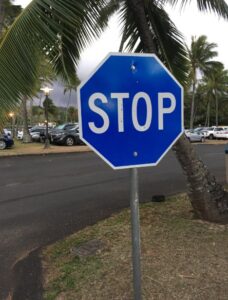
A blue stop sign looks almost identical to a traditional red stop sign—it’s still an octagonal shape and features the same white lettering that spells “STOP.” However, there is one critical difference: it’s blue. So, is this some new initiative, or is it just a mistake?
The reality is that blue stop signs are not legally recognized for traffic control in public areas, at least not in the United States. According to the Manual on Uniform Traffic Control Devices (MUTCD), which sets strict guidelines for all official road signs, stop signs must be red with white lettering. Blue, unfortunately, does not meet the standards set by the U.S. Department of Transportation. Therefore, blue stop signs are not officially used for government-regulated traffic control.
While these signs function like any other stop sign—telling drivers to come to a complete stop before proceeding—they are not part of the national traffic system. They are generally found in private areas, such as private communities, parking lots, campuses, or industrial sites.
Where Can You Find Blue Stop Signs?
Because blue stop signs do not follow the official standards, they are most commonly found outside public roadways, typically on private property. Here are some of the places where you might encounter a blue stop sign:
1. Private Communities or Gated Neighborhoods
In some private residential areas, such as gated communities, property owners may choose to install blue stop signs to indicate intersections or areas where traffic should be controlled. These signs are not legally required, but they help to guide traffic flow in a controlled environment.
2. Parking Lots
Parking lots—whether for businesses, shopping centers, or residential complexes—may also have blue stop signs. They are used to direct vehicles, especially in large parking structures where traffic can get congested. They’re intended to ensure safety, but they don’t have the same legal status as red stop signs on public streets.
3. University Campuses
Some universities or colleges might use non-standard signage, including blue stop signs, for aesthetic reasons or to create a unique, branded look for their campus. While the signs function in the same way as their red counterparts, they are not part of the federally regulated signage system.
4. Industrial and Commercial Sites
Large industrial facilities or businesses often use custom signage for internal traffic control. These signs could be blue and are often used to mark stop zones in areas like warehouses, distribution centers, and manufacturing plants.
Why Are Stop Signs Typically Red?
If you’ve just come across a blue stop sign, you’re probably wondering: why are stop signs usually red in the first place? What makes red the go-to color for something as important as a stop sign?
1. Early Stop Signs Weren’t Always Red
It might surprise you, but stop signs didn’t always have to be red. In fact, when the first stop signs were introduced in the United States in the 1910s, they were yellow with black lettering. Back then, reflective materials weren’t widely available, so yellow was chosen as it was one of the most visible colors both during the day and at night.
2. The Shift to Red
By the 1950s, advancements in reflective coatings made red a better option. Red became the default color because it’s strongly associated with warning and danger, making it the perfect choice for something as important as a stop sign. Red is highly visible and instantly grabs attention, which is crucial when it comes to traffic control.
In 1954, the U.S. Department of Transportation officially adopted red stop signs with white lettering. This color choice stuck, and today, red is universally recognized as the color for stop signs in many parts of the world.
Color Psychology and Traffic Signs
The colors of traffic signs are carefully chosen based on how the human brain perceives different hues and their associated meanings. Colors are used to trigger specific reactions, such as urgency or caution. Red, for example, is linked to stop, danger, and alert, which is why it’s used for stop signs.
Here’s a quick rundown of some common traffic sign colors and their meanings:
- Red: Danger, prohibition, stop (e.g., stop signs, yield signs).
- Green: Directions or safe movement (e.g., exit signs, directional arrows).
- Blue: Information and services (e.g., rest areas, hospital signs).
- Yellow: Warning of hazards or changes in conditions (e.g., caution signs).
- White/Black: Regulatory information (e.g., speed limits, parking signs).
Are There Other Unusual Stop Signs?
While blue stop signs are certainly rare and unusual, they aren’t the only non-standard stop signs that exist. In fact, a variety of creative, experimental, and region-specific variations have popped up over the years.
1. Fluorescent Yellow Stop Signs
In an effort to increase visibility, especially at night, some areas have experimented with fluorescent yellow stop signs. These signs are more visible in low light conditions, and they’re sometimes used at particularly dangerous intersections where visibility is a concern.
2. Bilingual Stop Signs
In areas with a large population of non-English speakers, bilingual stop signs are common. For example, in Quebec, Canada, stop signs say “Arrêt” instead of “Stop.” This ensures that drivers who don’t speak English can still understand the instruction.
3. Black-and-White Stop Signs
Some private communities prefer a more minimalistic aesthetic and have opted for black-and-white stop signs. These versions still serve the same purpose, but they have a different visual style that fits the community’s branding.
4. Flashing LED Stop Signs
To enhance visibility, especially at dangerous intersections or high-speed roads, flashing LED stop signs are sometimes installed. These signs are equipped with small lights that blink to draw attention, alerting drivers to stop more effectively.
5. International Variations
In some countries, stop signs can look quite different from what we’re used to. For example, in Germany, stop signs are in the shape of an octagon but have a white border and red background. Other countries have made variations to better suit their own traffic needs.
Should You Stop at a Blue Stop Sign?
You might be wondering: What should I do if I encounter a blue stop sign? Should I treat it like a regular stop sign, or is it just a decorative piece?
The best course of action is to treat a blue stop sign like any other stop sign when you encounter one. Even though it’s not legally regulated, it’s still placed there for a reason, and ignoring it could lead to accidents or confusion. In private communities, businesses, or parking lots, ignoring a stop sign, regardless of its color, could result in safety hazards or conflicts with local enforcement, especially if there’s security on site.
If the blue stop sign is placed in an area with little traffic or no active enforcement, you may get away with not stopping, but it’s better to err on the side of caution. In areas where there is potential for accidents, stopping as you would at a traditional stop sign is always the safest choice.
Conclusion: The Purpose of Blue Stop Signs
Blue stop signs may seem out of place at first, but they exist for specific reasons. While they don’t meet official federal guidelines and aren’t used for government-regulated traffic control, they serve an important function in private spaces like residential communities, parking lots, and industrial areas. Whether they’re used to manage traffic flow, enhance safety, or even add a visual touch to a private location, blue stop signs exist to regulate vehicles and ensure safety, just like their red counterparts.
It’s essential to remember that not all traffic signs are created equal. Whether they follow official guidelines or not, these signs exist to manage the flow of vehicles and reduce the likelihood of accidents. So, the next time you encounter a blue stop sign, take a moment to stop, just like you would at any other stop sign, and proceed with caution.
After all, the goal isn’t just to follow traffic laws—it’s to keep yourself and everyone else on the road as safe as possible.