Faith, Flags, and the Halftime Divide: How a Counter-Stream Ignited America’s Loudest Cultural Argument… – nganha
.
Faith, Flags, and the Halftime Divide: How a Counter-Stream Ignited America’s Loudest Cultural Argument
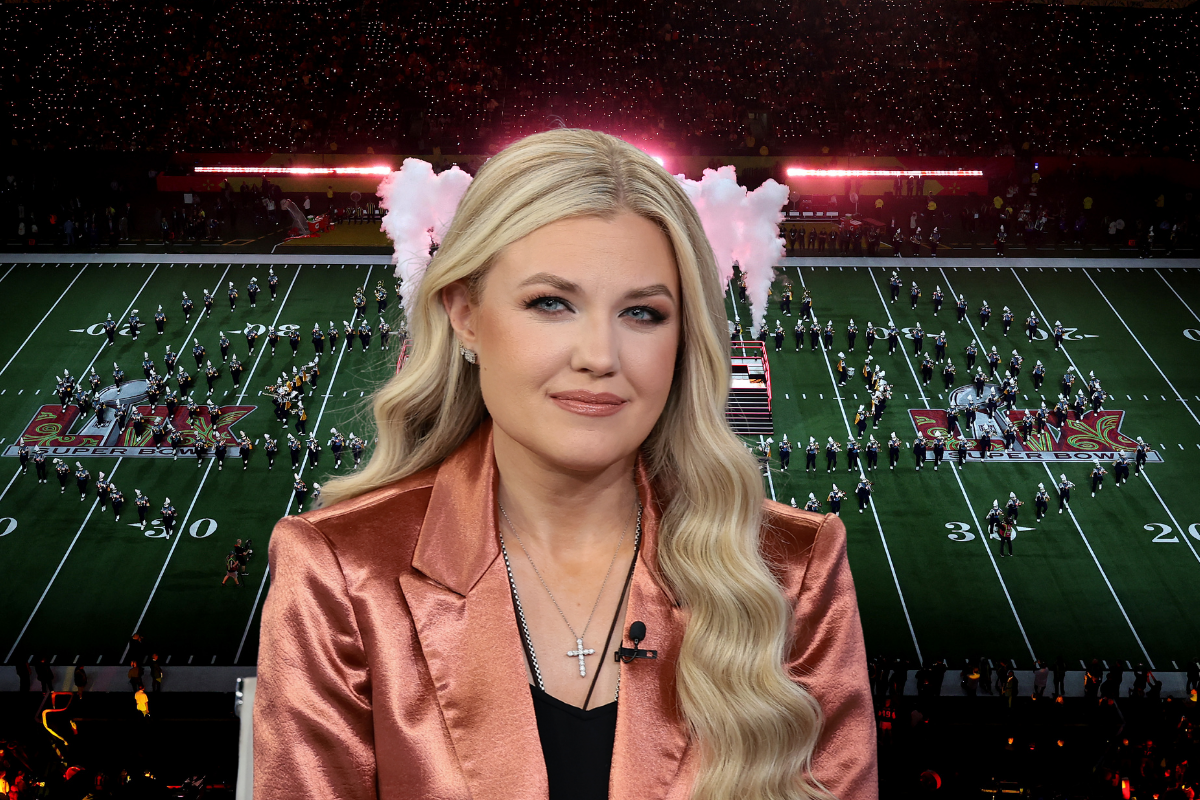
America woke up the morning after Super Bowl LX to more than box scores and commercials, because a parallel broadcast had quietly detonated a cultural argument that refused to stay off the internet.
Turning Point USA’s “All-American” halftime stream ran alongside the NFL spectacle, offering a patriotic, faith-forward alternative that instantly split timelines, group chats, and comment sections across the country.
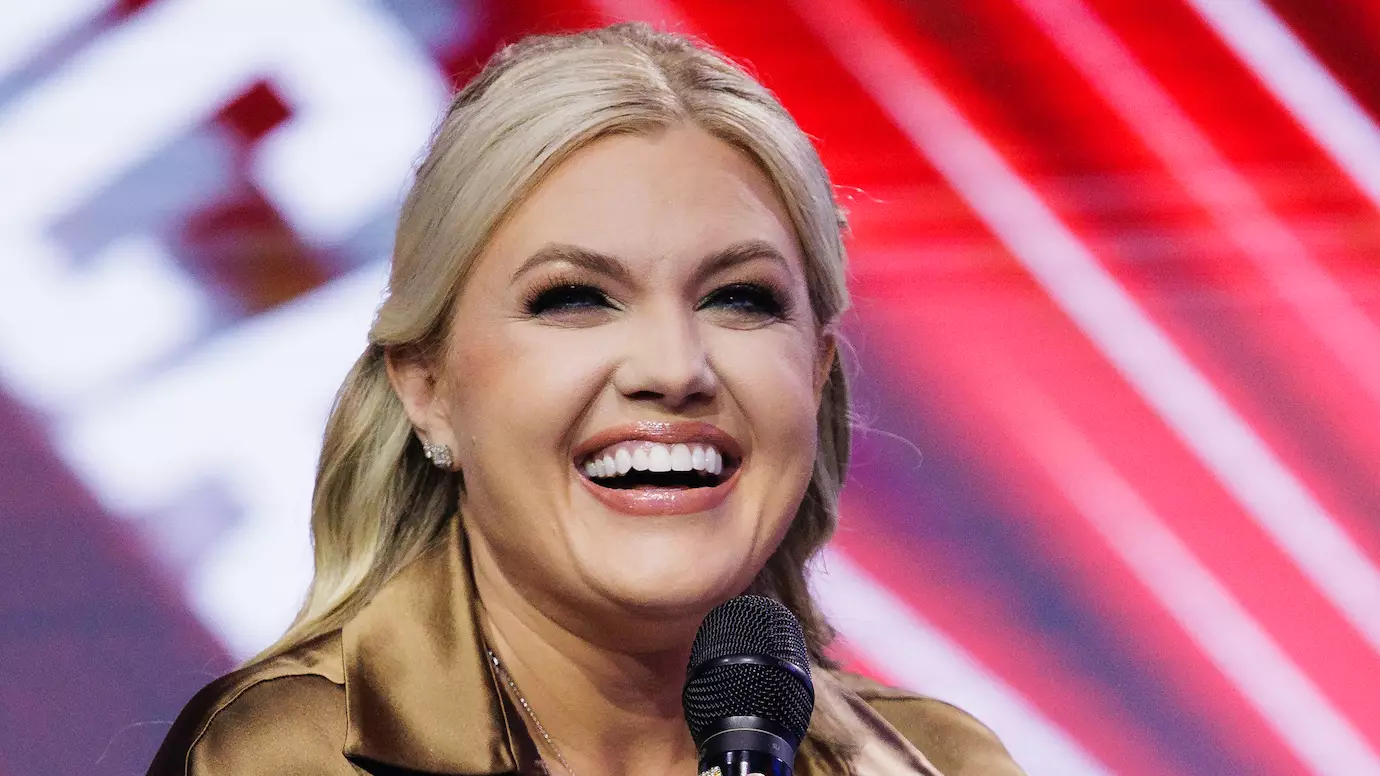
At the center of the storm stood Erika Kirk, CEO of Turning Point USA, who broke her silence with a message that blended grief, conviction, and defiance in a single emotional statement.
She framed the broadcast not merely as political programming, but as a deeply personal tribute to her late husband, founder Charlie Kirk, whose legacy continues shaping conservative youth culture.
Thanking what she called “the millions” who tuned in, Erika wrote that Charlie “would’ve absolutely loved it,” anchoring the event in memory, mourning, and an unapologetic sense of purpose.
Her message closed with a line that ricocheted across social media feeds: “It’s okay to love Jesus and your country,” followed by a tender dedication, “I love you Charlie baby, this is all for you.”
For supporters, the words felt like a long-suppressed exhale, a declaration that faith and patriotism still deserved center stage in a culture they feel increasingly hostile.
For critics, the same sentence sounded like a dog whistle, a calculated provocation injected into America’s most-watched sporting event under the banner of grief and remembrance.
This tension is precisely why the alternative halftime stream became one of the night’s most debated moments, even rivaling the official show in online engagement and emotional intensity.
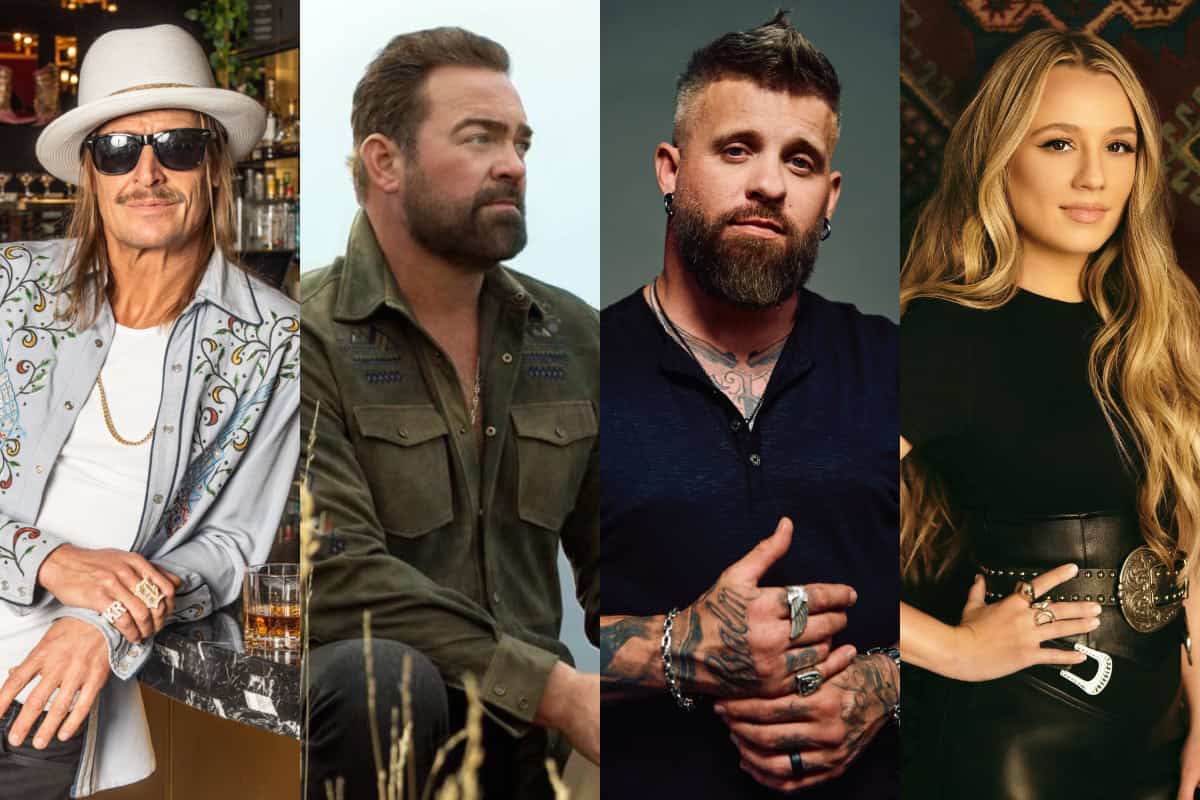
Featuring performances from Kid Rock, Brantley Gilbert, Lee Brice, and Gabby Barrett, the broadcast leaned hard into country aesthetics, Christian symbolism, and unapologetic Americana.
Fans praised the lineup as authentic, heartland-driven, and refreshingly disconnected from what they describe as Hollywood’s moral grandstanding and coastal elitism.
Detractors dismissed it as culture-war theater, accusing Turning Point USA of exploiting national tragedy, religion, and entertainment to score ideological points during a shared civic moment.
What neither side could deny was the reach, as clips circulated at lightning speed, memes multiplied, and hashtags collided across platforms designed to reward outrage and emotional certainty.
Super Bowl halftime has long been a cultural mirror, but this year it functioned more like a split screen, revealing two Americas watching the same clock yet inhabiting different realities.
Erika Kirk’s statement added fuel because it blurred lines between public leadership and private loss, making criticism feel, to supporters, like an attack on a grieving widow.
Opponents countered that public platforms invite public scrutiny, and grief does not exempt powerful figures from accountability when messaging intersects with politics and religion.
This unresolved argument reveals something deeper than a single broadcast, pointing to a nation struggling to agree on where faith belongs in shared cultural spaces.
For many Americans, Christianity remains inseparable from national identity, woven into personal history, family traditions, and moral frameworks that feel increasingly sidelined.
For others, such displays feel exclusionary, implying that true patriotism requires religious alignment, a notion they see as incompatible with pluralism and constitutional ideals.
The phrase “It’s okay to love Jesus and your country” became a Rorschach test, interpreted as either a reassurance or a rebuke, depending entirely on the reader’s worldview.
Social media algorithms, optimized for friction, ensured that the most extreme interpretations rose fastest, flattening nuance and rewarding certainty over conversation.
In that environment, Erika Kirk’s words transformed from a personal dedication into a viral slogan, stripped of context and amplified for maximum emotional reaction.
Supporters shared the quote alongside American flags, crosses, and heart emojis, framing the moment as a brave stand against cultural marginalization.
Critics reposted it with captions warning of creeping theocracy, culture-war opportunism, and the erosion of boundaries between church, state, and spectacle.
Meanwhile, the artists involved found themselves dragged into the discourse, praised as heroes by some and condemned as complicit by others.
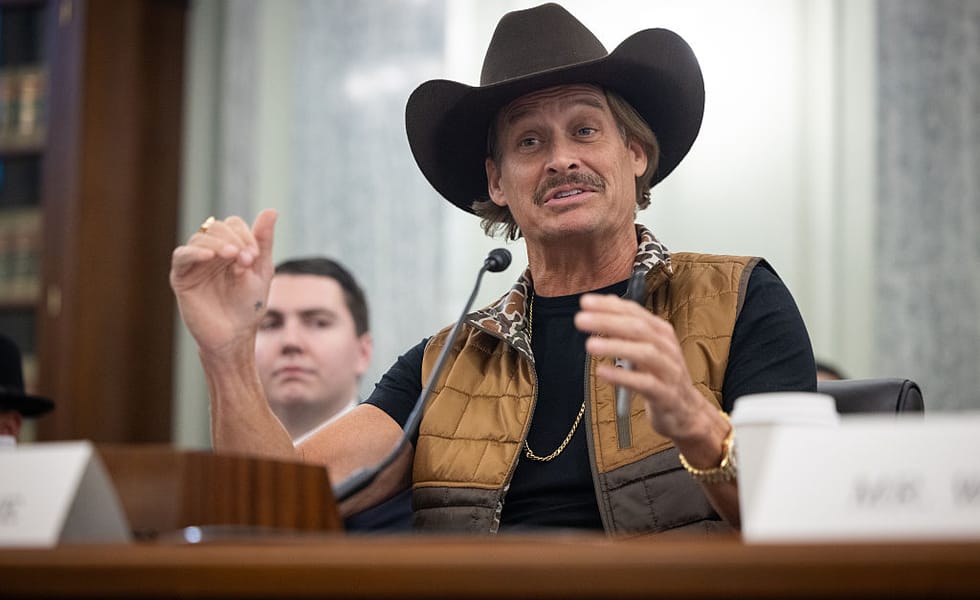
Kid Rock’s appearance, in particular, reignited long-standing debates about celebrity politics, authenticity, and the performative nature of rebellion in modern entertainment.
What made the controversy uniquely potent was its timing, arriving during a unifying national ritual that historically promised temporary escape from political exhaustion.
Instead of escape, viewers received a reminder that no cultural moment remains neutral, and every platform now doubles as a battleground for values and identity.
Erika Kirk did not attempt to soften the backlash, nor did she retreat into corporate ambiguity, choosing instead a tone of conviction rooted in personal loyalty.
That refusal to apologize resonated with an audience tired of public figures walking statements back under pressure from trending outrage cycles.
Yet the same refusal hardened opposition, reinforcing fears that polarization is no longer a side effect, but an intentional strategy.
The question now circulating is not whether the broadcast was appropriate, but whether shared cultural experiences can survive without fragmenting into ideological silos.
Super Bowl LX may be remembered less for touchdowns and commercials, and more for exposing how even halftime has become a proxy war for America’s soul.
In honoring her late husband, Erika Kirk inadvertently highlighted the power of narrative, showing how memory, faith, and politics intertwine in moments of mass attention.
Her message was simple, but its implications were anything but, touching nerves that extend far beyond one organization or one evening.
As the clips continue circulating, the debate shows no sign of slowing, fueled by influencers, commentators, and everyday users seeking validation through shares and likes.
Some argue this controversy proves the hunger for alternative voices in mainstream spaces, a rejection of what they see as enforced cultural consensus.
Others warn it signals the breakdown of common ground, where even entertainment cannot exist without ideological alignment tests.
What remains undeniable is the scale of engagement, a metric that social platforms translate into relevance, visibility, and future amplification.
In that sense, the “All-American” halftime stream achieved exactly what modern media rewards: attention, emotion, and division packaged as authenticity.
Whether history judges it as courageous expression or calculated provocation will depend on who controls the narrative in the months ahead.
For now, Erika Kirk’s words continue echoing across feeds, screens, and conversations, a reminder that loving Jesus, loving country, and loving controversy have become inseparable online.
And as America scrolls, argues, and shares, one truth emerges clearly: the loudest halftime show this year didn’t happen on the main stage, but in the comments below.
AT THE EDGE OF IDENTITY: HOW SENATOR JOHN NEELY KENNEDY’S MIDNIGHT VOTE FORGED A NEW BATTLE OVER CITIZENSHIP, POWER, AND THE AMERICAN IDEA-phuongchi
Just after midnight, the United States Senate delivered a vote that instantly fractured consensus and reignited one of the nation’s oldest, most emotional debates.
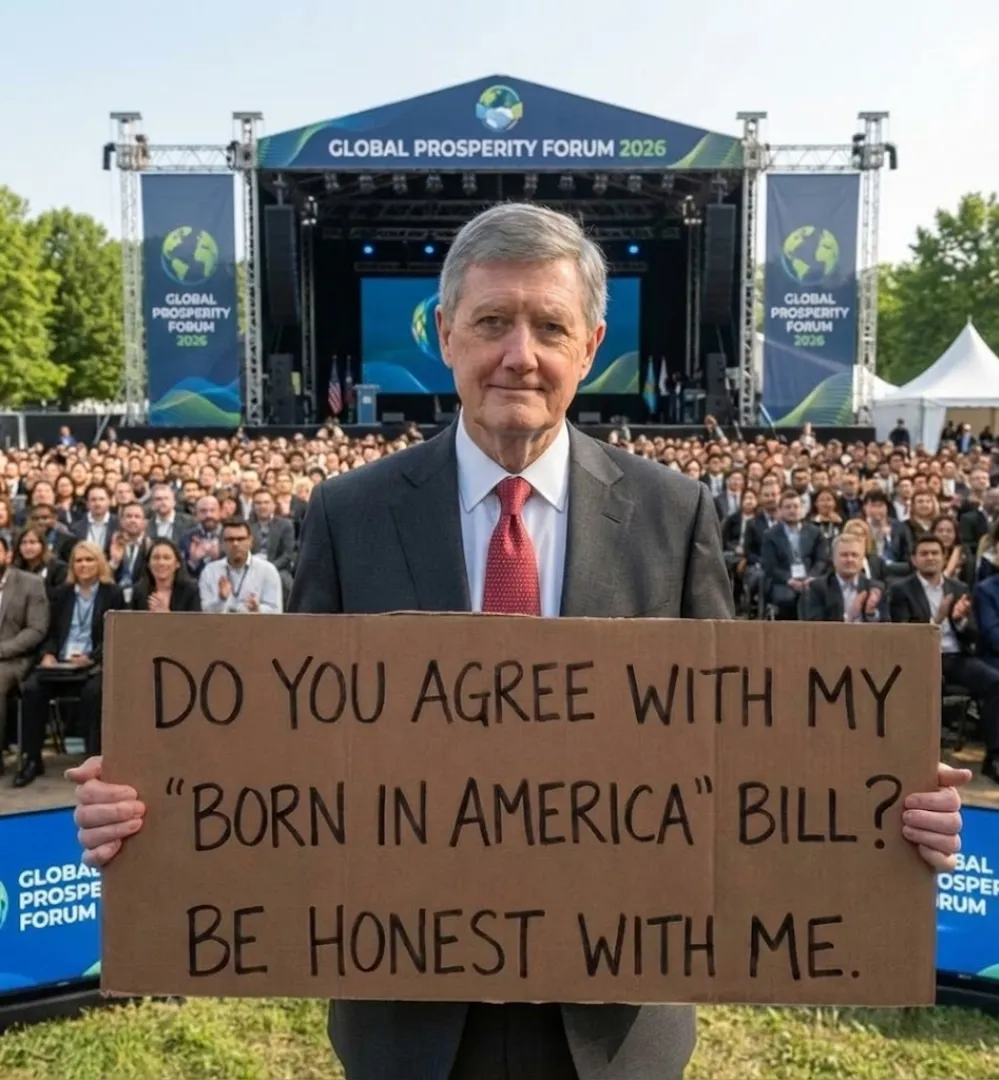
By a razor-thin margin, Senator John Neely Kennedy’s “Born in America” bill cleared the chamber, sending shockwaves through politics, law, and public consciousness.
The final tally, 51 to 49, reflected not only partisan division but a deeper cultural split over what it means to belong in America.
Supporters called it a defense of sovereignty, while critics labeled it an exclusionary turning point.
The bill mandates natural-born citizenship as a prerequisite for holding key federal offices, extending beyond existing constitutional language into new statutory territory.
Its passage followed hours of procedural maneuvering, fiery speeches, and late-night negotiations that stretched patience and tempers alike.
Republican senators held near-unanimous support, framing the measure as a long-overdue clarification of national loyalty.
Democrats stood united in opposition, warning that the bill undermines America’s immigrant legacy and constitutional balance.
When the vote deadlocked, Vice President JD Vance stepped in to cast the deciding vote, sealing the bill’s advance.
That moment, brief yet historic, crystallized the stakes and amplified the sense that the Senate had crossed a consequential threshold.
Senator Kennedy, visibly energized, addressed the chamber with words that immediately circulated nationwide.
He framed the bill as a safeguard against divided allegiances and foreign entanglements at the highest levels of government.
“Our leaders must have loyalty forged from birth on American soil,” Kennedy declared, drawing applause from supporters.
“To protect the Republic, there can be no ambiguity at the top.”
For Kennedy’s allies, the bill represents clarity rather than hostility.

They argue that leadership demands the highest standard of undivided national allegiance.
Opponents responded with equal force, accusing the legislation of narrowing the American promise.
They warned that it casts suspicion on naturalized citizens who have long served the nation with distinction.
Senate Minority Leader Chuck Schumer condemned the vote as a retreat from America’s founding ideals.
He argued that allegiance is proven through commitment, not birthplace.
“This country was built by those who chose America,” Schumer said, his voice rising.
“Not just by those who happened to be born here.”
The chamber reacted with visible emotion, cheers colliding with protests in a rare display of raw intensity.
Even seasoned senators acknowledged the unusual gravity of the moment.
Outside the Capitol, the reaction was immediate and explosive.
Social media platforms lit up within minutes of the vote’s conclusion.
The hashtag #BornInAmerica surged to the top of global trends, drawing billions of impressions overnight.
Supporters hailed the bill as “America First leadership protection,” while critics branded it “nativist exclusion.”
Viral clips of Kennedy’s speech and the midnight vote spread at breathtaking speed.
Millions replayed the decisive moment, dissecting every word and gesture.

President Donald J. Trump quickly weighed in, celebrating the outcome with emphatic praise.
He framed the bill as a bulwark against foreign influence and urged swift House passage.
Legal scholars immediately entered the fray, offering sharply divided interpretations of the bill’s constitutionality.
Some argue it merely reinforces the natural-born citizen principle already embedded in the Constitution.
Others contend the legislation overreaches, potentially violating equal protection principles.
They warn it could invite prolonged court battles with unpredictable consequences.
The bill now heads to the House of Representatives, where its future remains uncertain.
Several lawmakers have already signaled resistance, citing both legal and moral concerns.
Civil rights organizations announced plans to challenge the measure if enacted.
They argue it creates a hierarchy of citizenship incompatible with democratic equality.
Supporters counter that the bill affects only a narrow set of offices.
They insist it does not diminish the rights or dignity of naturalized citizens.
Yet critics note that symbolism matters as much as scope.
They argue the message sent by the law could ripple far beyond its immediate application.
Public opinion appears sharply divided, reflecting broader national polarization.
Polls taken hours after the vote showed near-even splits across ideological lines.
For some Americans, the bill represents reassurance in an era of global uncertainty.

They view it as a necessary assertion of national boundaries and identity.
For others, it feels like a narrowing of the American dream.
They fear it signals a shift toward exclusion rather than inclusion.
The midnight timing of the vote added to its dramatic resonance.
Moments decided in darkness often carry an outsized sense of consequence.
Commentators noted that late-night votes have historically marked inflection points.
This one, they argue, may join that list.
The debate extends beyond law into philosophy.
Is America defined by birthplace or by shared commitment and contribution.
That question has echoed since the nation’s founding.
This vote thrust it back into the center of public discourse.
Some historians argue the bill reflects cyclical anxiety about identity during periods of change.
They point to similar debates during past waves of immigration and geopolitical tension.
Others see a distinctly modern edge driven by social media amplification.
Digital platforms magnify emotion, accelerating polarization and simplifying nuance.
The bill’s supporters believe they are correcting drift.
Its opponents believe they are witnessing regression.
Neither side shows signs of retreat.
Both are mobilizing voters, donors, and legal strategies.
As the House prepares to consider the bill, pressure mounts on representatives.
Constituents flood offices with calls, emails, and protests.
Campaign strategists already see electoral implications.
The issue could reshape alliances and turnout in upcoming races.
International observers are watching closely as well.

America’s definition of leadership carries global symbolic weight.
Allies and critics alike interpret the debate as a signal of broader ideological direction.
Some see renewed nationalism, others a challenge to pluralism.
The Senate vote did not end the conversation.
It intensified it.
In town halls, classrooms, and online forums, Americans are debating identity with renewed urgency.
The question of who can lead has become inseparable from who belongs.
As dawn broke over the Capitol, the nation awoke to unresolved tension.
The Republic stood at a crossroads once again.
Whether the “Born in America” bill becomes law or falters ahead, its impact is already real.
It has reopened fundamental questions that refuse easy answers.
History will judge this moment not only by outcomes, but by what it revealed.
A nation still wrestling with its own definition.
The vote may be counted, but the debate has only begun.
And its echoes will shape American politics for years to come.