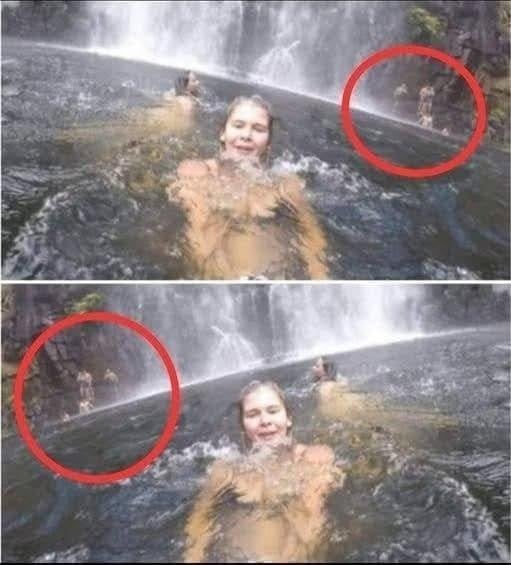
“I missed it at first as well, in case you don’t see it…”
At first, you barely notice it. The image slides past in the endless scroll, another frame in the river of content that seems dull, disposable, almost deliberately forgettable. It doesn’t call for attention. It’s just there, another digital artifact among millions. You’re only halfway paying attention, your mind elsewhere, and it takes someone else’s nudge to even pause the momentum. Then a whisper reaches you—sometimes literal, sometimes a comment, sometimes just a suggestion in your peripheral vision: “Look again.” And suddenly, everything changes.
Your pulse tightens, a shiver runs down your spine. You stop scrolling. You rewind the clip, zoom in on corners you never considered. Your eyes dart across the frame like a detective’s, scanning every shadow, every reflected glint, every odd angle. There’s a subtle shift somewhere—a shadow that moves against physics, a reflection in glass that doesn’t match reality, a hand slightly out of place. What once felt casual, even mundane, now tilts toward something uncomfortable, something uncanny. The image is no longer passive; it demands engagement. What you thought was background noise becomes the center of your focus.
The thrill, of course, comes from discovery. Each object, each layer of detail, each pattern or discrepancy might be a clue. You stare at that tiny imperfection—the curl of a curtain, the misplaced book on a shelf, the barely visible face in a mirror—and it feels monumental. When your brain finally snaps the pieces together, when the hidden element crystallizes in your mind, the rush is disproportionate to its size. It might be nothing more than a shadow, a reflection, a small object out of place—but in that instant, it feels like you’ve cracked a code that only you could see. There’s a satisfaction in that revelation that is almost electric, a confirmation that you’ve been paying attention, that your curiosity has been rewarded.
This is why such images, videos, or posts spread so rapidly online. They transform passive viewers into active participants, turning casual scrolling into a hunt. Every like, every share, every comment carries the weight of someone saying: “I saw it. I got it. You should too.” The post ceases to be just content; it becomes a shared experience of perception, a puzzle passed from person to person. Virality, in these moments, is less about spectacle and more about the intimate thrill of noticing what most people miss.
And beneath this, there’s a quiet lesson about how we perceive the world in general. The detail wasn’t hidden in any mystical sense. It was always there, part of the frame, present in plain sight. The problem isn’t that we can’t see it—it’s that we move too fast, we scroll too quickly, we consume too passively. Only when someone—or something—forces us to pause do we notice the subtle complexities, the anomalies, the overlooked truths. It’s a reminder that attention is not automatic; it is trained, earned, and sharpened by curiosity. And in a world that constantly floods us with images, our ability to notice, to pause, and to truly see becomes a rare and exhilarating skill.